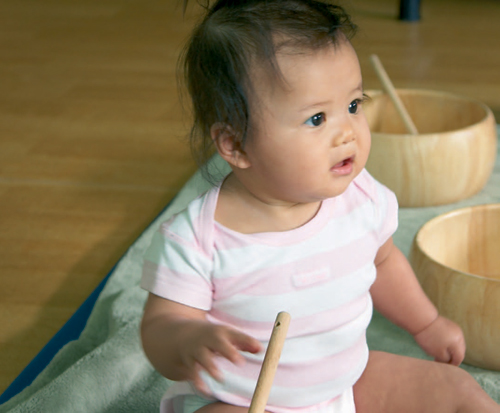

Leaving an infant in the care of relative strangers for the first time is, understandably, a stressful experience for parents. Sarah Ockwell-Smith gives suggestions for how to help ease any separation anxiety.
Much is made of attachment theory, yet I wonder whether we truly understand its implications. As a professional and mother of four, I speak from experience when I say that sometimes I feel childcare settings don’t truly appreciate the trauma some families experience when using childcare for the first time.
I have often seen well-meaning nursery workers peeling a sobbing child or screaming baby off of an equally distressed mother with reassurances of, “It will be okay, don’t worry.”
The mothers walk away with tear-stained cheeks, desperately trying to not look back. The nursery workers speak in jolly voices trying to cajole toddlers with the promise of a sticker or story, or bounce babies whilst playing peekaboo.
The fact is, though, it’s not okay. In the case of a securely attached mother-infant dyad, both will be experiencing trauma in the above situation.
The abrupt separation of the child from his or her ‘secure base’ is not something that can be ‘got over’ in minutes or hours.
The child will stop crying for its parent, but usually because of ‘learned helplessness’ or distraction. In both cases the emotions are very much still present, and that’s okay.
It is important to realise that these feelings are very real and valid. We need to acknowledge them, rather than try to silence them.
Only then is it possible to move on to the ultimate goal – that of a truly happy child and a happy parent whilst using childcare.
For many parents, the first day at nursery will have been in their mind for a long time. The first few months with a newborn are often marred for mothers by the looming date when they will return to work and have to leave their child in somebody else’s care.
Leaving their child, particularly a baby, for the first time can be heartbreaking to a new mother.
Many parents are also deeply concerned about finer details, many of which they don’t feel comfortable discussing with their chosen childcare provider. Concerns I hear commonly from parents about to use childcare for the first time include…
Listening is so important. Don’t be tempted to say “don’t worry”, “don’t be silly” or similar, all of which dismiss a parent’s feelings.
Instead, you could say, “I can see you’re very upset, that’s okay, it’s a really big thing. How can I help?” which validates feelings and shows your genuine concern.
Asking lots of questions about the child’s life at home, personality and preferences can really help. Do it in person, not via a questionnaire.
This shows genuine interest and, importantly, the parent is reassured that you have heard them.
Encourage the parent to ask anything that is on her or his mind, especially something she/he feels might be silly to ask. It is often these points that bother them the most!
It can be tremendously helpful to offer peer support to parents from those who have been in a similar situation.
Do you have a parent or two at your nursery who had a tough start but whose child is now thriving? Would they be open to talking to new parents about their journey?
A key person becomes a replacement attachment object for the child. Therefore it is vital that they form a good bond with each other.
Both the parent and child need to meet the key person several times before starting day. It is also helpful to give the parents a photograph of the key person for them to take home and refer to, building recognition and bonding at home.
Young children do not process and store information in the same way as adults. Providing a visual prop for the parent to use before starting day can be very helpful.
This might be a small scrapbook with pictures of the nursery and other staff that parents can use at home.
If the child already has a comforter, a cuddly toy, for instance, this should always come with them to nursery. Never take it away.
If the child doesn’t have one, encourage parents to try to condition one a good month before nursery starts. They can do this by involving the comforter in hugs, cuddles and feeds with their child.
If the baby or toddler has had a bad day don’t be tempted to lie. It is always better to tell the truth. Use this as an opportunity to discuss how you can improve things with the parent.
Is it possible for you to be more baby- or toddler-led with the day’s rhythms in any way?
Using slings and carriers can be an amazing way to settle fractious babies and non-sleeping toddlers. You can learn more at babywearing.co.uk
If a child is failing to settle into your setting, don’t be afraid to suggest that perhaps the parents may want to consider alternatives.
This is really pertinent if it is relating to a toddler starting preschool. I believe many toddlers are forced to start before they are ready. Waiting just another few months can make a dramatic difference.
Imagine that you have spent all your life with only one or two people. Initially you thought that you and your mother were one being, such was your connectedness.
Over time you realised that you were two different people. Howevr, she was always there, whenever you felt scared, nervous, or in need of reassurance. She was your ‘safe haven’.
Slowly you grow, safe in the knowledge that you can always go back to her when you need her. This is how real confidence and independence develops. It cannot be forced.
When a child’s neural connections are sufficiently formed they begin to branch out on their own, but always safe in the knowledge that their attachment figure is there for them.
Now imagine that this connection is abruptly severed. You are placed into the arms of a relative stranger and your mother deserts you.
You have no grasp of the concept of time, or understanding of whether she will even return at all. Everything in your world has changed.
Can you imagine the turmoil? How would you feel if you were told, “It’s okay now, be a big girl and stop crying then you can have a biscuit”? Would that really make you feel better? Empathy for children, as well as parents, is vital in a childcare setting.
Sarah Ockwell-Smith is a parenting expert and author, and the founder of Gentle Parenting.