Emma Davis shares what today’s Early Childhood Studies students are learning – and the skills they’ll soon be bringing into settings…
This year our Early Childhood Studies students at University College Birmingham have covered an unusually wide range of ground.
All experiences, opportunities and learning link to their modules of study but also develop wider skills required as graduate practitioners.
Students need the theory from lectures and wider reading, but their knowledge is also informed through placement experiences, with them completing at least 200 hours per year.
Our Level 4 students have had a jam-packed start to their university experience, with preparation for placement from our Employability Tutors, an introduction to the Graduate Practitioner Competencies (GPCs) and learning from a range of modules, including:
A highlight was a day with Amanda Burton Smith from the Froebel Trust, whose interactive session offered an introduction to the pioneer whose ideas still shape practice a century on.
Linked to Nurturing Children’s Health and Wellbeing, a session with Teresa Johnson from Startwell highlighted to students the importance of healthy eating and physical activity and discussed the role of early years practitioners in promoting healthy lifestyle habits.
It wasn’t all about theory for this cohort, as we also value the personal, social and emotional aspects of learning, just like in early years.
Students organised an Eid celebration, which was a time of connection where students and teaching staff came together to enjoy homemade treats and to listen to stories of how they mark the occasion.
Level 5 students put their placement experiences into practice by working on an exciting project with Cosy Direct.
They were tasked with creating a new resource, bringing together their knowledge of child development, inclusive practice and theory.
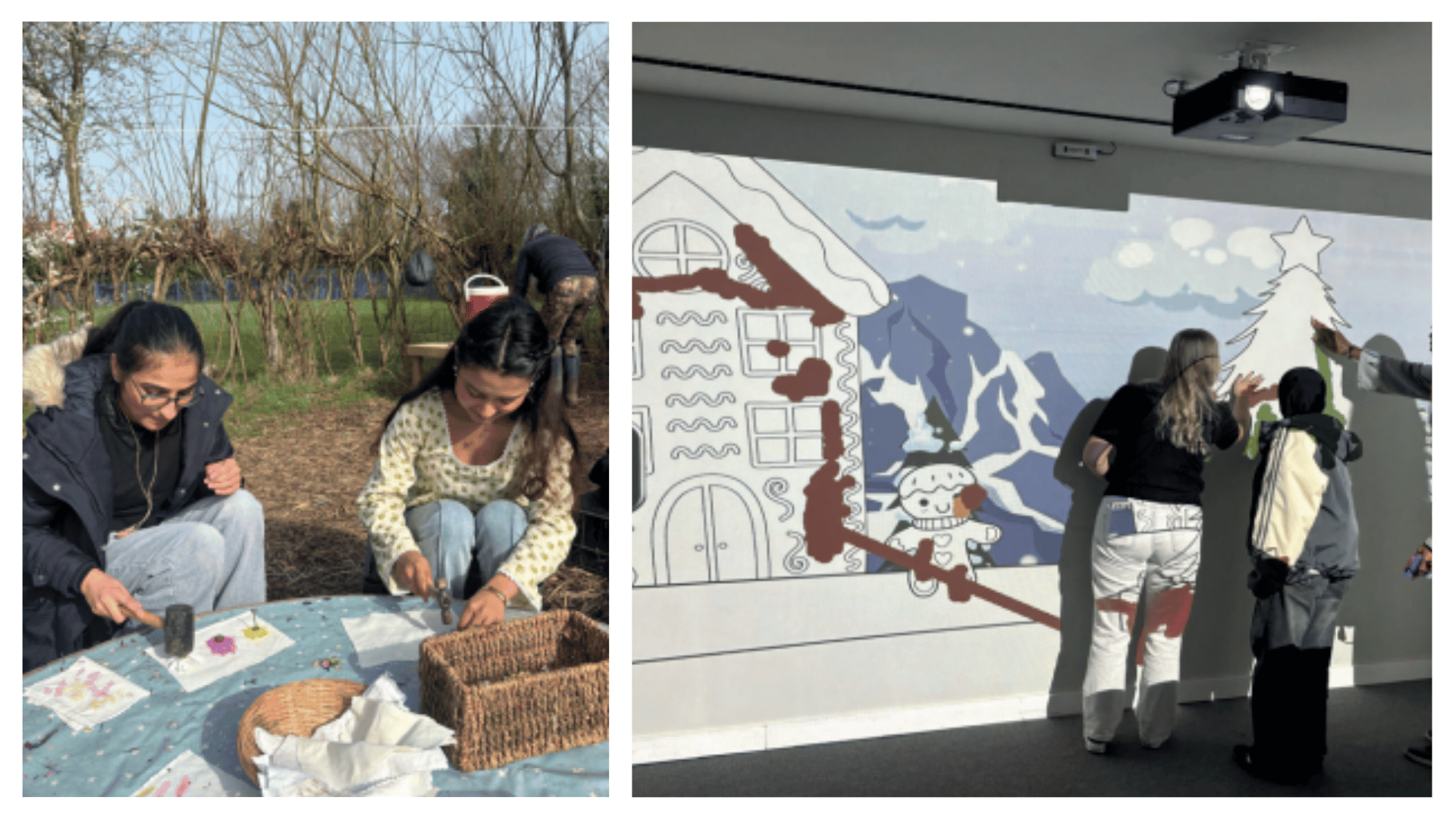
As part of their Skills for Success development, they also took a trip to Thinktank Birmingham to look at how museums and public learning spaces support children’s curiosity and communication, and practised carrying out risk assessments.
Students came back talking about pathways they hadn’t considered before (museum education, outreach teaching and community learning roles), evidence of how these experiences can reshape how a student sees their future.
A highlight for the Level 6 students was visiting Pedmore C of E Primary School in Stourbridge for a forest school day, run through Fruits of the Forest.
They learned the history of forest school, its influence on children’s holistic development, and how to manage risky play.
Activities included hapazome, clay play, bug hunting, music making and outdoor role play, plus cooking lunch on the fire and practising mindful meditation. Students left with ideas they can use directly in placement.
One of the richest sessions of the year came out of a question posed in an Enhancing Employability seminar: Do accents matter?
The discussion followed a piece by Alexander Baratta on accent expectations in British teacher training, with students thinking about identity, what it means to hear your own voice reflected back in a classroom and whether a Brummie accent means the same thing in 2026 that it did a generation ago.
They asked whether the responsibility for being understood sits with the speaker or the listener, and applied the same question to children, who arrive in our settings already hearing a wide range of accents.
I’ve taught for a long time and it’s rare to hear a group think that carefully together, in real time, changing their minds as they listened to each other.
Make time in a staff meeting to talk honestly about accents: your own and each other’s in the team. Consider the assumptions that are made about intelligence, competence or background based on someone’s accent, and whether those assumptions influence how staff are treated or how children are spoken to.
When a child comments on how someone says a word, respond with interest rather than correction. “You say that differently to me, how interesting” keeps the moment open rather than shutting it down as a mistake.
Bring stories to life with different accents. This is important in enabling children to hear different ways of saying words which are representative of our society.
Invite a parent or grandparent to record a favourite story in their own accent, then play it back in the setting. Children hear directly that their family’s way of speaking is also welcome and valued in the setting.
If a child needs help with a new word, model it clearly. If they’re simply pronouncing it in their own accent, that isn’t something we try to fix, as it’s just as important for them to know words can be said in different ways.
Notice whether you change how you speak in front of parents, inspectors, or managers, and ask why. Modelling comfort with your own accent gives children permission to keep theirs.
Level 6 students also welcomed Sean Delaney from CREC, who spoke about initial teacher training routes, and met Verity Campbell-Barr when she visited for the ECSDN AGM.
Talking with them directly gave students a real sense of the research and policy world their degree connects to.
Across all levels, students attended the launch of the second edition of Birth to Five Matters, completed their 200 placement hours, and took part in Makaton training.
Dissertations were underway for our final-year students throughout, alongside the usual end-of-year celebrations that all cohorts deserved after a demanding year.
Walking into my placement for the first time, I felt a mixture of excitement and nerves. Moving to a new country meant I was also adapting to a different curriculum, a new setting, and children I had never met.
I wasn’t sure what to expect, but the experience quickly became far more rewarding than I had imagined.
One moment that has stayed with me was meeting a little boy who cried every morning and clung to his parents. I soon realised that before children can learn, they need to feel safe, secure, and valued.
Through patience, consistency, and gentle reassurance, I watched him gradually build trust. Seeing him happily wave goodbye to his parents and confidently join his friends reminded me of the importance of strong relationships in early years education.
This placement has increased my confidence, communication skills, and ability to build positive relationships with children and families.
During the session, I practised basic signs, facial expressions, and everyday phrases that make communication easier to understand in everyday situations.
What stood out most was the emphasis on patience, repetition, and the importance of visual aids alongside speech. It challenged my assumptions about communication, as it does not always depend on words.
After the session, I reflected on how often everyday conversations can leave out those who communicate in different ways, without us realising it.
Emma Davis is a senior lecturer in education at University College Birmingham.

“Nurseries Aren’t All Nappies and Nursery Rhymes”
Editors picks

Interview: Training to Support Toddlers
Ace-Owner