Most parents considering boarding for younger children arrive at the decision with a familiar mix of hope and worry.
The academic case is clear enough, but the questions that keep them up at night are different: Will my child feel lonely? Will they cope without us? Will they know how to ask for help? These are exactly the right questions to ask, and a well-run international boarding school should have compelling, concrete answers to all of them.
Boarding school emotional resilience, in simple terms, is a child’s growing ability to notice and name their feelings, bounce back from everyday setbacks, try again after failure, and reach out to the right person when they need support. It is not toughness for its own sake. Good boarding schools do not leave children to sink or swim; they coach them through challenges in age-appropriate ways, using structured routines, consistent adults, and a community of peers to do what no classroom lesson can replicate.
This article walks through what daily life in a quality international boarding house looks like, how its routines and pastoral structures intentionally build emotional resilience, independence, and social skills, and how the multicultural nature of an international cohort adds a layer of adaptability that prepares children for life well beyond school. It closes with a practical checklist of questions parents can use when assessing any boarding provision they visit, including international programmes such as Harrow International School Hong Kong’s.
For a child in their primary or early secondary years, emotional resilience shows up in small, everyday moments: calming down after a disappointing match, apologising to a friend and meaning it, sitting with a difficult feeling rather than exploding or shutting down, and knowing when to ask a trusted adult for help rather than letting a problem fester. It is not the absence of distress; it is the capacity to move through it.
These skills have direct consequences for learning. A resilient pupil is more willing to attempt work they find hard, receive critical feedback without crumbling, and try a different approach after a poor result. Children who can manage frustration tend to stay engaged rather than give up, and that quality pays dividends in every subject and every stage of education that follows.
Resilience also supports healthy relationships. Living alongside peers means learning to apologise, forgive, set limits, and repair friendships after conflict. These are not instincts; they are practised skills, and they transfer directly into the teamwork, communication, and self-awareness that employers and universities consistently say they want to see.
Crucially, in a nurturing boarding setting, this capacity grows through guided practice in ordinary situations, not through hardship deliberately imposed. High-quality international boarding programmes build it intentionally through house systems, regular tutor meetings, and structured wellbeing education, treating social and emotional learning as seriously as they treat mathematics or languages. Harrow International School Hong Kong’s pastoral boarding approach reflects this thinking, treating holistic development not as a supplement to academic life but as its foundation.
A predictable daily rhythm is not merely convenient; it is psychologically protective. When children know what happens next and who will be there, they have the security to take small risks, try new things, and process difficult emotions without being overwhelmed by uncertainty. In a well-run boarding house, the structure from morning to bedtime is built with this in mind.
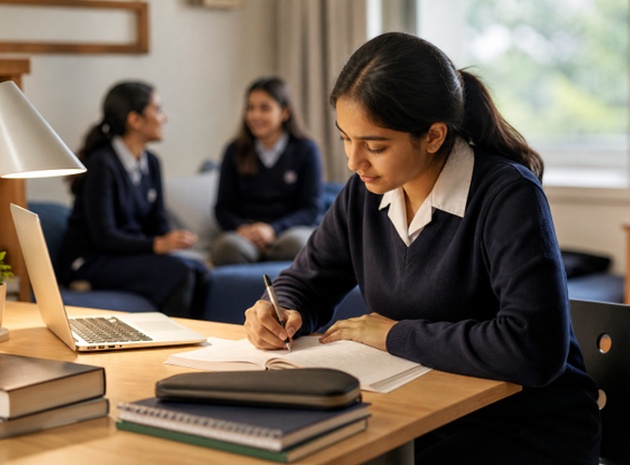
A typical weekday begins with wake-up calls and room checks, followed by a shared breakfast that teaches negotiation, turn-taking, and the social rituals of communal life. The school day is followed by supervised prep, where staff do more than enforce quiet: they model how to break a large task into steps, manage distractions, and plan work across the week. Evening brings co-curricular activities, downtime, and a calm wind-down before sleep, and each element of that sequence is deliberate.
The daily tasks that might seem mundane – making beds, organising uniforms and equipment, getting to meals on time, managing laundry and personal space – are the practical foundations of self-management. They are practised with supportive oversight rather than perfectionist pressure, so children build competence gradually rather than feeling either over-protected or overwhelmed.
Age-appropriate progression matters here. Younger boarders typically benefit from visual schedules, more frequent check-ins, and gentle reminders from house staff, while older pupils are given more autonomy: greater choice over activities, more responsibility for managing their own time, and leadership roles within the house. Screen time and sleep are managed with clear, consistent policies, device hand-in times, and quiet hours that protect emotional regulation as much as physical rest.
International boarding programmes often weave cultural celebrations, language support, and global awareness activities into this rhythm too, giving children from different backgrounds regular moments to feel seen and to learn about one another. Parents exploring Harrow International School Hong Kong’s boarding provision will find that these gradual, supported steps towards independence are woven into boarding life itself, offering a useful example for families considering boarding school in Hong Kong.
The difference between a boarding school that builds resilience and one that merely expects it lies in the adults and systems surrounding the child. A strong pastoral framework is layered: house parents and resident staff who know each pupil personally; form tutors who track academic and emotional progress over time; school counsellors and nurses who provide professional support; and, in many schools, trained peer mentors who offer the particular reassurance that only a slightly older classmate can give.
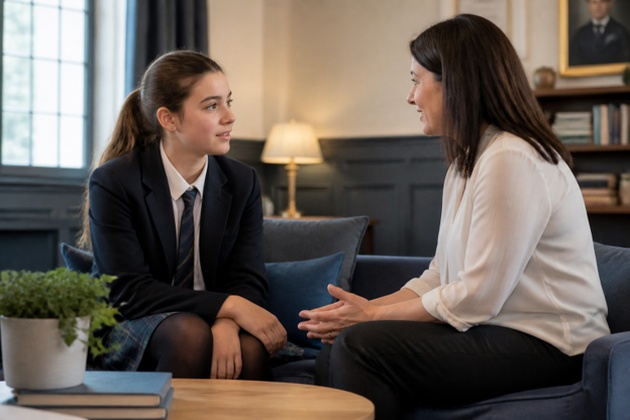
At the heart of this is the house system, which creates a home within a school. Children are known by name, their moods and friendships are noticed, and concerns are picked up early rather than escalating unnoticed. Regular tutor or house meetings are used to talk through everyday challenges, whether homesickness, a falling-out with a friend, or anxiety about upcoming assessments. The goal is not to fix every problem for the child but to help them reflect, identify options, and take the next step themselves.
Homesickness deserves particular attention because it is what parents worry about most. Good pastoral practice normalises the feeling rather than treating it as a failure: staff create comforting rituals, establish agreed times for calls home, help the child stay connected to the social life of the house, and set small, achievable goals rather than pushing for instant toughness. Children who are allowed to feel homesick and are then coached through it develop stronger coping skills than those who suppress it.
Conflict between pupils is handled as a learning opportunity. Staff listen to each side, teach respectful language and perspective-taking, guide pupils to negotiate, and follow up to make sure the relationship has been genuinely repaired. Safeguarding frameworks sit beneath all of this, with clear supervision policies, staff training in child development and trauma awareness, and protocols for raising concerns, so that pupils are safe enough to take healthy social risks.
For international schools, there is an additional layer: transition support for pupils arriving from overseas, who may be managing jet lag, language adjustment, and different cultural norms around asking for help, all at once. Skilled boarding staff anticipate these pressures and coach pupils through them explicitly. Harrow International School Hong Kong’s house-based pastoral model, with dedicated boarding staff across year groups, reflects this multi-layered understanding of what children arriving from different parts of the world actually need.
If daily routines provide the structure for resilience to grow, it is community life that provides the content. Living closely with peers means children are constantly practising the skills that matter most: sharing space, negotiating noise levels and bedtimes, taking turns, respecting others’ belongings, and reading the social temperature of a room. These are not abstract lessons; they happen before breakfast.
Disagreements and personality clashes are inevitable, and in a well-supported boarding house, they become some of the most valuable learning that takes place. Staff guide pupils to listen, to compromise, and to accept that they will not always get their way, while still maintaining their sense of self. The ability to hold one’s ground respectfully, and to repair a relationship afterwards, is a skill most adults would acknowledge they are still working on.
An international cohort adds a particular richness to this. When a child’s housemates come from a dozen different countries, speaking different first languages and bringing different customs, assumptions, and ways of seeing the world, the range of social learning is extraordinary. Children learn to ask curious questions rather than make assumptions, to adapt their communication, and to discover that their way of doing things is one among many equally valid approaches. In a well-run house, this becomes a genuine source of empathy, global awareness, and confidence in unfamiliar social settings.
Structured opportunities for leadership and service amplify this further. House captains, activity leaders, and the pupil who organises a cultural celebration evening are all practising responsibility, public speaking, and the care of others in a real rather than a simulated context. Shared experiences beyond lessons, whether a weekend hike, a house performance, or a service project, create bonds associated with the sense of belonging that is one of the strongest predictors of resilience.
International boarding programmes such as Harrow International School Hong Kong’s deliberately build this into the culture of their houses, celebrating different backgrounds and encouraging pupils to learn from one another as an everyday part of holistic development.
Good intentions and warm house staff are necessary but not sufficient. What distinguishes the best international boarding programmes is that social and emotional learning is structured and deliberate, not left to chance.
A personal, social, and health education curriculum, delivered in age-appropriate sessions, gives children a shared language for emotions, friendships, digital habits, sleep, and help-seeking. These sessions normalise the idea that struggling and asking for support is sensible, not weak, a lesson that proves especially important for pupils who come from cultures where self-sufficiency is strongly valued.
Evening and weekend activities, whether sport, art, outdoor education, or community service, serve a dual purpose: they give pupils healthy outlets for stress and genuine opportunities to discover strengths they would not have found in a classroom. A child who finds that she is calm and capable on a mountain trail, or that he can make a room laugh with a performance, carries that knowledge into harder moments.
Planned reflection time, through tutor periods, house meetings, or quiet journalling, allows children to process the week, celebrate small progress, and set the next goal. This reinforces a growth mindset in the most practical way possible, not as a poster on a wall, but as a repeated lived experience.
Transition programmes matter particularly at the start of a boarding journey. Taster nights, gradual increases in nights away from home, and induction weekends are not just logistics; they are the moments when younger and newer boarders begin to trust that they will be safe and known here. Communication with home is equally deliberate: regular pastoral updates from house staff, academic reports that include emotional and social observations, and agreed patterns of calls or messages that maintain connection with family without undermining the child’s growing independence.
Screen time and sleep policies round out the picture, with devices handed in before bed, filtered Wi-Fi, encouragement of face-to-face interaction in the evenings, and calm pre-bed routines that support the emotional regulation children need to sleep well and face the next day steadily. Harrow International School Hong Kong’s pastoral boarding approach brings all of these elements together, from dedicated wellbeing education to rich co-curricular programming and clear home-school communication, as part of a coherent model of child development.
A school visit is an opportunity to look beyond facilities and brochures and probe the everyday reality of pastoral life. The questions below will help you do exactly that.
Start with the people who will know your child best. Ask how house parents and boarding staff are recruited and trained: what do they know about child development, mental health first aid, safeguarding, and intercultural awareness? How long do house parents typically stay in post? High turnover in those positions undermines the consistency that is central to a child feeling known and secure.
Ask specifically about transition support. What happens in the first two weeks for a new or younger boarder? How does the school identify a child who is struggling socially rather than simply appearing fine? What are the early interventions, and how are parents kept informed without being alarmed?
Explore the daily structure in detail. How are wake-up, prep, free time, and lights-out managed? How does this evolve as pupils get older? What are the policies on mobile phones, gaming, and screen time, and how consistently are they applied?
Ask to see or hear about the formal pastoral architecture: the house system, the tutor cycle, access to school counsellors, and the process by which concerns are shared between the boarding house, the academic team, and parents. Is there a structured wellbeing curriculum? How are friendship difficulties, online behaviour, and bullying handled in practice, not just in policy?
Finally, look and listen during the visit itself. Do pupils greet adults with ease? Do they seem comfortable in communal areas? Can staff give you a specific, recent example of how they helped a pupil work through a setback and come out more capable for it? If they can, you are looking at a school that does not just talk about building resilience but actually practises it.
These questions apply to any boarding school you consider. Use them when exploring international options such as Harrow International School Hong Kong, whose pastoral boarding information sets out how its house system, wellbeing education, and home-school communication work together to give children the daily support they need to grow in confidence, independence, and genuine emotional strength.

 follow us @TeachEarlyYrs