Jude Harries suggests simple calming activities to help children slow down, relax and reflect…
Supporting anxious children, including helping them to self-regulate and keep calm, seems to be a bigger part of early years teaching today than ever before.
Basic deep-breathing exercises are a good place to start, and the other calming activities below will help you take it further and hopefully create a calmer learning environment for you and those in your care.
You may also find it useful to employ the mindfulness technique S.T.O.P., developed by Jon Kabat-Zinn. S.T.O.P. is an acronym for these four essential steps: Stop – Take a breath – Observe – Proceed mindfully.
It’s important to help the adults in your setting keep calm too. Invite all staff to follow the S.T.O.P. technique and join in the calming activities with the children.
Encouraging children to notice their breathing is a good way to help them slow down and feel calm. Ask them to stop what they’re doing and listen to their breathing (they can be sitting down or standing up).
Ask them to place one hand on their tummy and count “one, two, three” as they breathe in. Can they feel their tummy growing like a bubble?
Wait… and then breathe out slowly, counting to four, as though blowing soap bubbles. Can they blow a bigger bubble by breathing in and out more air?
Gather the children together on the carpet with a soft toy or teddy for this calming activity. Ask them to lie down and place the toy on their tummy.
Invite them to breathe in slowly, then breathe out and watch as the toy moves up and down. The children will take deeper breaths to make the toys move more, and as their breathing deepens, they’ll feel calmer.
Try this gentle chant as they breathe:
Breathe in, move up / Breathe out, move down / Teddy’s resting on my belly / Teddy’s wobbling like a jelly.
Invite the children to sit and make themselves comfortable. Can they imagine they’re holding a favourite cupcake?
Breathe in as they smell the cake. Then imagine there are two candles on the cake. Can they exhale and blow them out?
They can use their fingers as candles and blow them out in turn.
Now, light a real candle, and invite children to watch it. Talk about how the flame flickers. What happens if they breathe out near the candle? Invite a child to blow out the candle and watch the smoke curl away
Begin or end the day with a smiley circle game. Invite the children to sit in a circle and point out some smiley faces. Smiling is usually quite contagious, so see if you can spread it around the circle!
Ask one smiley child to pass their smile around the group by turning to their neighbour and smiling. If some children are shy and reluctant to smile, provide a toy with a smiley face or a printed-out emoji for them to use.
Can the children think of some things that make them smile to share with the circle (favourite food or toy, seeing mummy at the end of the day, a funny joke)?
Listening to music is a good way to create a calm atmosphere in a setting. Gentle instrumental pieces such as the piano solo “Clair de lune” by Claude Debussy, “Spiegel im Spiegel” by Arvo Pärt, or Pachelbel’s “Canon in D” are all good options.
Alternatively, try more ambient tracks or nature sounds – there are lots to choose from on YouTube!
Another way for children to use their musical minds is to provide a small keyboard and headphones for them to experiment with and create their own calm music.
Books can help change the energy in a room. After a busy or energetic activity, guide children to the carpet or tables to select a book to look at.
Use picture books, fiction and non-fiction, puzzle books, and notebooks, as well as drawing materials. Display a timer and encourage the children to focus on a book for three minutes.
Some children might prefer to share a book with another child. Some might like to read to a friend or small group. Others might need one-to-one input from a member of staff, but they can all appreciate the benefits.
Invite children to join in this finger “brain break”. Ask them to pretend to glue their thumbs together so they don’t move.
Number the fingers 1–4, starting with the index finger (1) and ending with the little finger (4). Touch the fingertips together as you count to four.
Start slowly and gradually get faster. Try calling out different sequences of numbers for the children to follow: 4, 3, 2, 1 or 2, 4, 2, 4.
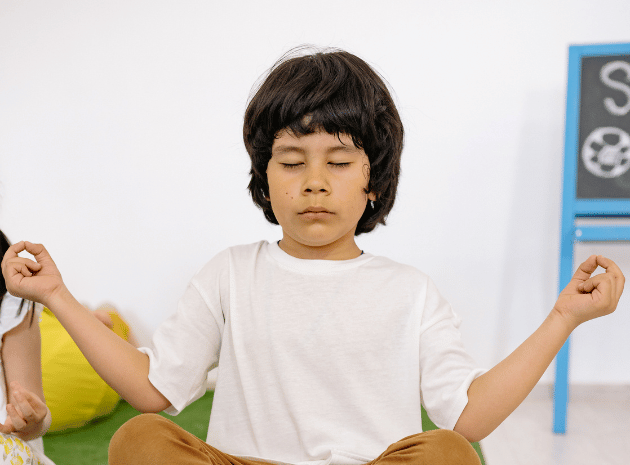
Try these simple yoga poses with the children. Start by sitting with legs crossed, hands resting on knees, and index fingers and thumbs touching.
Close your eyes and breathe. Make a downward dog pose. Start on all fours, tucking the toes under, and pushing the bottom into the air like an upside-down “V”.
Breathe and try a few quiet barks! Finish with the child pose. Start on all fours, rest the bottom back onto the feet and stretch arms in front, head resting on the floor.
Another favourite for calming down children after a busy PE session or game is Sleeping Bunnies. Invite them to lie on the floor in a sleeping position as you sing:
See the little bunnies, sleeping ’til it’s noon / Shall we wake them with a merry tune? / They’re so still, are they ill? / No… Wake up, bunnies! / Hop, little bunnies, hop, hop, hop / Hop, hop, hop / Hop, hop, hop / Hop, little bunnies, hop, hop, hop / Hop and STOP!
This calming activity works particularly well with a small group of children around a table. Provide each child with a small piece of playdough to hold in one hand.
Encourage them to look closely at the dough, to see its colour, shape, size and weight. Invite children to move the dough between their hands, squishing it, stretching it, rolling it, and watching it change.
Some children might choose to turn it into something and want to share their dreams; others might not make anything specific but still enjoy the experience.
Set up a designated space in your setting for children to take “time out” if they need to calm down. Provide a comfortable seat, cushions and blankets, picture books and some mindful props such as a basket of pebbles or shells, leaves and feathers, fidget toys, and soft toys.
Show children how to use the calm corner effectively. Emphasise keeping it tidy and trying to use quiet voices. Invite the children to feed back and suggest changes.
These are sometimes called “calm-down bottles” and are easy-to-make jars or bottles full of coloured water, small amounts of glue and, of course, lots of glitter.
Before shaking them, observe the glitter sitting separately at the bottom, settled, calm and still. Feeling angry or upset can be mirrored by the glitter as it swirls about like jumbled thoughts when the jar is shaken.
For children, just watching the slow-motion movement of the glitter as it settles back down again can be calming.
Jude Harries is an author and teacher of music and drama, with experience of working with children aged nine months to 11 years.
Using magnets – Exploring their potential in Early Years
Editors picks