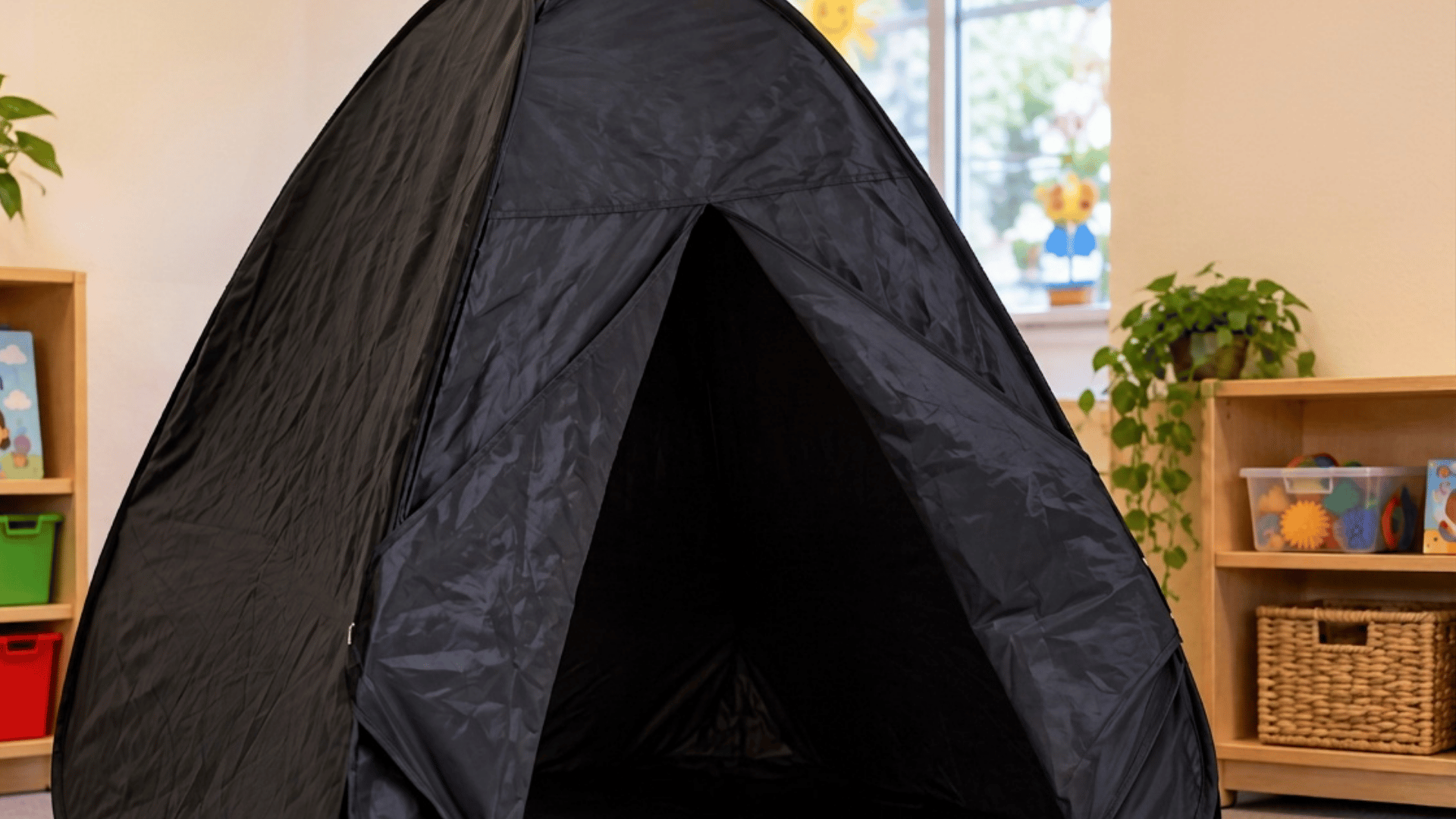
Providing a sensory tent or similar place for children with autism to go if they are feeling overstimulated is a must for every inclusive setting, says Debby Elley…
Autistic minds are busy places. A 2013–2014 study by researchers from Case Western Reserve University and the University of Toronto found that, on average, autistic children’s brains produce 42% more information than non-autistic ones while at rest.
There’s every chance, then, that an autistic youngster in your busy early years setting will at some point experience overload.
This is pretty evident when they’re distressed – hiding, avoiding or crying. It’s less easy to spot when there’s a quiet lack of engagement (which can also be down to social communication difficulties) or they are hyper-focusing on an object.
Even making a lot of their own noise can sometimes be a sign that a youngster is blocking out overwhelming stimulation.
While the staff at mainstream settings can’t be expected to interpret all these behaviours without the help of an occupational therapist, entertaining the possibility of overload is a great start.
Having a place to escape before everything gets too much is a key resource that should be available in every education setting.
Some nurseries have readily available quiet areas, but not all have that luxury. Being inclusive means setting up one of your own.
Here are some hints to help you create a calm space…
This isn’t about providing a make-believe play area, but a quiet zone. In this respect blackout sensory tents (sometimes known as dark dens) are useful.
Sensory tents can get stuffy and warm – keep it aired (i.e. its windows open) and sit with the child or just outside the tent; have them visible.
Don’t wait for a child to experience overwhelm; give them the chance to use the space at regular intervals. Never force its use, but let them know it’s available.
Be clear this isn’t a play tent, and neither should it ever be used as a form of punishment – nursery managers need to be especially clear to staff about this.
Its use needs to be driven by the needs of the autistic child, not the adult. Call your sensory tent the Quiet Tent. Stick to soft cushions, weighted items and calming sensory objects.
Avoid using turn-taking language that makes it sound like a toy.
Ask the other children if they would be allowed to play with a guide dog. No, that’s for people who need it to help them get around.
In the same way, the sensory tent is for children whose brains are especially busy and need quiet and calm every so often, so that they can think clearly.
Talk openly about what feeling overwhelmed is like and why some bodies need more quiet in order to feel better.
A good way of explaining it is to use two bottles – one full of water and one full of lemonade. Show the children that the lemonade (brain that works differently) is fizzy; it’s busy all the time, and when shaken up (with lots of things to do) it takes a while to calm down.
The water bottle (non-autistic brain) isn’t so fizzy, and after being shaken it calms down quickly.
Make a rule that a grown-up will help you decide if the sensory tent is the right place – always. No exceptions. Use picture signs to indicate: “Calm tent only” / “Ask a grown-up”.
If the sensory tent is the only calm space, it’s too exciting to resist. Balance it with other quiet corners, with soft seating and beanbags, books, headphones or a cosy mat space for other children.
Finally, make sure you place the quiet area or sensory tent away from the main foot traffic, so it doesn’t become connected to the rest of the classroom activities.
Debby Elley is an author and the co-founder of AUKIDS magazine. She provides autism training to early years settings.

Daily Mile – 15 minutes of physical fun
Editors picks

3 Ideas to Improve Your Learning Environment
Editors picks