It needn’t be expensive to practise the Montessori method, says Dr Helen Edwards…
The name Maria Montessori is synonymous with beautiful settings featuring natural materials and specialist resources. However, in these cash-strapped times, it can feel unattainable.
However, many early years educators are following Montessori principles without even realising it. If you enter a setting and see low, open shelving, children pouring their own water, or an educator kneeling to observe rather than standing to “teach”, you are seeing the living legacy of the Montessori method.
Here are five approaches you may wish to try that don’t need investment in expensive resources.
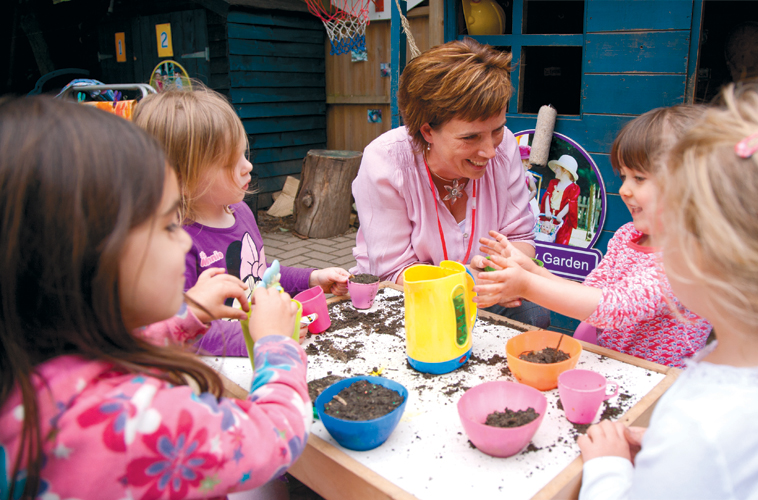
Montessori famously eschewed “pretend” plastic toys in favour of real, purposeful materials. Compared to plastic, she felt wooden materials offered a “sensory honesty” with weight, varied textures, and distinct scents.
You might introduce small china jugs for pouring, metal spoons and pans for cooking, or an area for real woodworking tools.
Some Montessori educators extol the value of “loose parts” such as stones or shells for supporting development and learning.
These can be sourced easily and help to ground children’s learning in reality. For example, the physical experience of holding a heavy stone compared to a feather helps a child to learn about weight more profoundly.
Early years education is underpinned by observing the child and what interests them. We act as guides or facilitators – not to disturb a child’s “flow” but to wait for the “teachable moment” or to offer a prompt that scaffolds the child’s self-chosen discovery.
This mirrors Montessori principles, where the educator steps back to see what a child is interested in before they intervene.
Perhaps Montessori’s greatest contribution to the early years is the emphasis on “following the child”. Rather than tightly defined curriculum statements that all children must complete, provision is planned according to a child’s interests and level of development.
For example, if a child is playing with dinosaurs in the sand, a Montessori-aligned teacher doesn’t force them to leave the sandpit to do a maths activity elsewhere.
Instead, they bring maths to the child, asking questions like “How many dinosaur footprints can we make?”
This respects the child’s “sensitive periods”. These are windows of time where they are primed to learn specific skills through the lens of their current passion.
By mapping your planning to a child’s fascinations, you’re following the Montessori method of individualised, child-led learning.
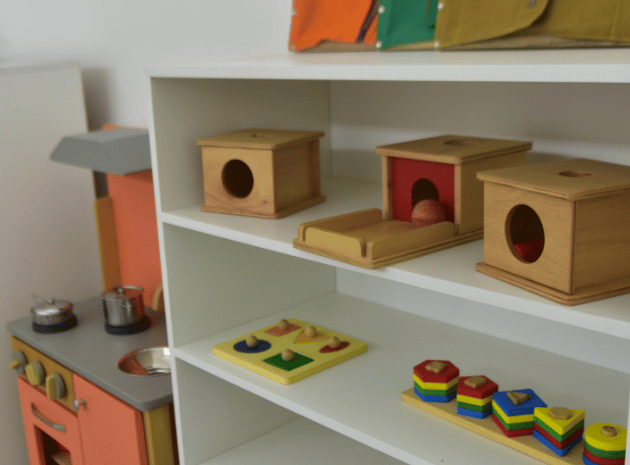
The Montessori prepared environment is a carefully designed classroom that fosters independence, order, and self-directed learning. Everything is purposefully placed and child-sized.
Offering accessible, continuous provision that has been specifically curated to support your children’s learning allows them to return to the same activity frequently.
They know where to find resources they need. This fosters the deep concentration Montessori called “the work of the child”.
Providing low shelves where resources are clearly labelled serves the need for autonomy. Keeping similar items grouped in baskets provides a sense of order to help the child feel secure and independent.
“Help me to do it myself” is a well-known Montessori mantra and another that’s easy to implement. For instance, helping children to develop their practical life skills by letting them learn to put on their coats or giving them small dustpans and brushes to clear up their own spills.
It’s about stepping back when a child struggles to fit the puzzle piece and allowing them to solve it themselves and experience the “Aha!” moment.
It shifts the goal from “getting it right” to the joy of discovery and helps build a child’s identity as a competent problem solver.
Dr Helen Edwards is co-founder of Tapestry and a former nursery owner. Recently, she interviewed Karen Chetwynd, CEO of Montessori Global Education, to discuss how the philosophy is relevant for all children. Find it at tapestry.info/podcasts

Outdoor play – the benefits of ‘wild’ spaces
Editors picks