Free, easy to organise, and accessible to all, the Daily Mile is the perfect way to get your children moving, explains Karen Hart…
Originating in 2012, the Daily Mile initiative is going from strength to strength. It’s the brainchild of Elaine Wyllie, a former headteacher from Scotland.
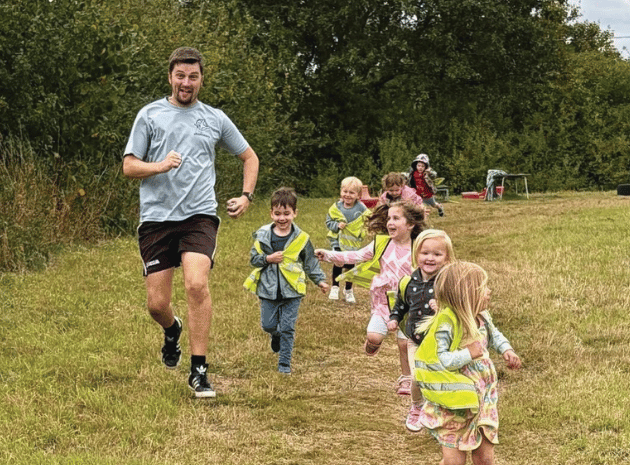
The scheme involves school pupils and early years children, walking, jogging, running, etc., for 15 minutes on a daily basis.
The aim is to improve children’s physical, social, emotional and mental health by embedding a culture of activity into their day, regardless of age or ability.
The Daily Mile is simple and free, with no special training or equipment needed. It’s perfect for nurseries, as it’s designed to be adapted to an individual child’s pace – wheeling, toddling, wheelchair users.
The focus is on fun, inclusion and building healthy habits, not distance covered. The challenge supports the EYFS through physical development, plus PSED and communication and language skills.
Get children ready by introducing the idea of the Daily Mile. During circle time, talk about lots of different types of sport. How many can children think of?
Talk about how they can take part in different kinds of physical activities. Everyone has their favourite ways to get moving.
Ask children to share their favourite PE games (running, playing football, dancing, the climbing frame, parachute play, etc.).
Then explain that they will all be taking part in the Daily Mile. This will give them lots of ways to get extra fit and healthy.
Ask children if they think an obstacle course, or walking round the playground while balancing a beanbag on their head, sounds like fun. Or maybe jumping in and out of hoops across the playground?
Ask for their suggestions for fun activities that everyone could do. Discuss why children think it’s important to include exercise and movement in their day.
Talk about how we feel after exercise (e.g. having more energy, feeling wide awake and ready to go!).
The Thrive Childcare Group has found many benefits from taking part in the Daily Mile. These include increased emotional wellbeing, confidence, resilience and self-regulation.
Its settings follow their 15 minutes of activity with some cool-down yoga. After this, children are engaged and ready for the rest of their day.
“We have been working with the Daily Mile for a number of years,” explains Ursula Krystek-Walton, Thrive’s head of early years.
“We recently organised a relaunch on September 1st, and all of our forty-six sites across Scotland and North West England continue to participate each week.
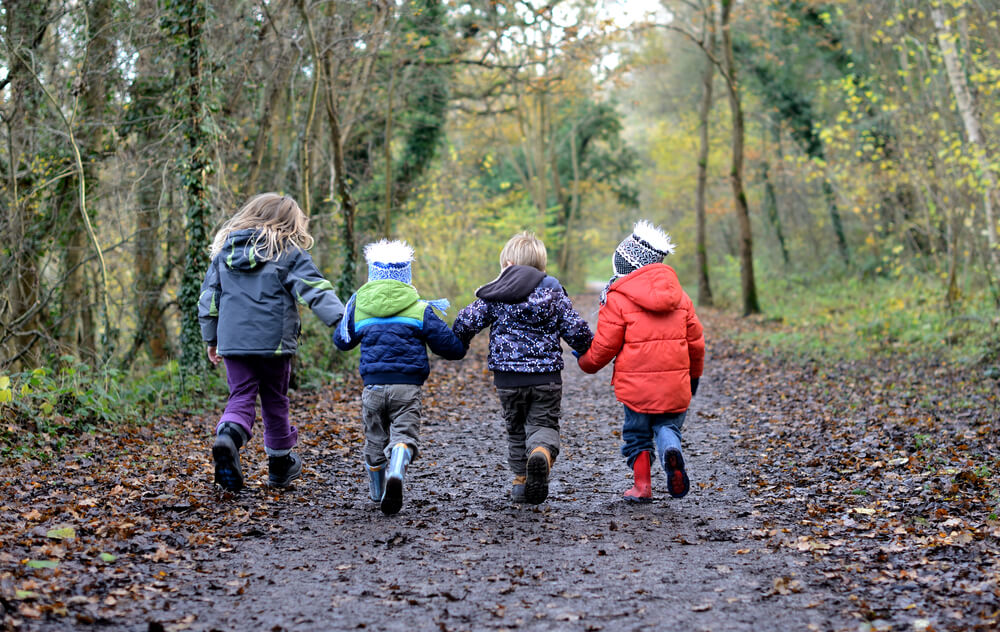
“The children are encouraged to walk, run, jog, etc. for fifteen minutes in their nursery’s outdoor space or a local park.
“Our children love it. They run, wheel, or walk outdoors with friends, moving at their own pace. The noncompetitive nature means every child succeeds, and the social aspect helps relationships flourish.
“There’s no equipment, no prep, and no changing into kit. Just fifteen minutes, at least three times a week, at a time that suits the nursery, and it works in almost any weather.”
When planning physical development activities for early years, keeping things simple, fun and non-competitive is key, as is considering the individual child’s level of ability and enthusiasm for physical play.
Pushing toys in buggies along a marked track will be just the right amount of challenge for some, while others will be up for something more ambitious, such as an assault course involving a climbing frame, crawl tunnels and balance beams.
The following activities are all suitable to use as part of the 15-minute Daily Mile challenge for early years.
Everyone has at least one old remote control they’re not using any more, and this fun game is a really good use for it.
Start by showing children how to make sure they have enough space around them to safely dance by spinning round in a circle with their arms out like an aeroplane.
Next, play some lively music popular with your group for everyone to dance along to. Tell children you have brought along your magic remote control that will get everyone dancing in lots of crazy ways.
When you press pause, everyone must freeze – make a big deal of pressing the button as you call out, “I’m pressing the button… now!”
Press the button again to restart the action, but this time tell children they will all be dancing like wild tigers, stopping the action with the remote control again in the same way.
Carry on the game by telling children to dance as lots of different creatures – monkeys, robots, jellyfish, penguins, etc., with an adult demonstrating each one, so children have some help getting started.
Early learning goal: Move energetically, such as running, jumping, dancing, hopping, skipping and climbing.
We changed the old favourite (the floor is lava) to ice, as this was a concept young children found easier to grasp.
Start by arranging lots of safe areas for children to step on around your playing space, such as mats, floor cushions, beanbags, foam floor tiles, etc.
When you shout, “The floor is ice!” everyone has to find something to stand on – or get their feet frozen! We have lots of screaming as children try to quickly get off the floor.
We like to play this game to music, with children dancing around the playground, but you can play without music if that’s easier for you.
Either way, this is one of those really simple games that quickly becomes a favourite, and which is great for developing strength, balance, coordination and spatial awareness.
Early learning goal: Negotiate space and obstacles safely, with consideration for themselves and others.
We play this game to the “Baby Shark” song, but for those who can’t bear to hear it any longer, another perfect piece of music is “Aquarium” from The Carnival of the Animals, by Camille Saint-Saëns.
To play the game you need two adults holding a long length of material (preferably something blue or greenish and silky) across your playing area.
Children take turns to run through it, pretending to be sharks, mermaids/ mermen, octopuses, jellyfish, sea horses, etc., with adults swishing the material up and down to look like a big wave.
It’s a good game for practising early running skills and coordination while playing.
Early learning goal: Demonstrate strength, balance and coordination when playing.
This activity works best if you have a bubble machine, but you can also blow the bubbles yourself. Simply blow lots of bubbles for children to catch and pop.
Give instructions throughout the game, such as, “Can anyone find two bubbles joined together?” or “Can anyone find a really big/really tiny bubble?”
Ask children to jump and catch the highest bubble they can reach, and to catch a bubble without bursting it. It’s a good game for developing coordination and spatial awareness.
Also use the activity to talk about the colours and shapes of the bubbles. Children could draw them using coloured chalks on black paper.
Early learning goal: Negotiate space and obstacles safely, with consideration for themselves and others.
Karen Hart is an early years specialist, drama teacher and writer.
Early Years bikes – Why you should say bye to yours
Editors picks