Phil Armstrong explains how sensory-rich outdoor learning activities can boost children’s fine motor skills…
Fine motor development is often associated with indoor activities, yet many of the essential foundations are created outdoors.
For children aged two to seven, outdoor continuous provision offers rich opportunities for strengthening hands, wrists and shoulders, while supporting the progression from broad exploratory movement to more refined tool control.
With thoughtful planning, outdoor environments can provide a rich pathway for physical development across both EYFS and KS1.
Fine motor control relies on strength and stability as well as precision, and outdoor play naturally promotes these.
Activities such as lifting, climbing, hauling, digging and pulling help build the shoulder girdle and core muscles. These underpin grip control and handwriting fluency.
When children practise these movements repeatedly in meaningful contexts, they develop the physical readiness needed for fine motor accuracy.
The sensory richness of outdoor learning makes it ideal for embedding fine motor skills in inspiring ways that complement, rather than mirror, learning opportunities indoors.
Here are some suggestions to consider…
Broad movement to greater control…
2 to 3: Young children benefit from large-scale mark making using chunky chalks, thick paintbrushes and rollers dipped in water.
These experiences promote whole-arm movement and help children strengthen their shoulders and elbows.
4 to 5: Children begin to show improved control and dexterity. Provide smaller chalks and brushes, sticks for drawing in sand or soil, and clipboards for nature investigations and writing “on the go”.
6 to 7: In KS1 continuous provision, mark-making outdoors can be used to greatly enrich learning across the curriculum. Include opportunities for map drawing, observational sketching and recording linked to outdoor investigation.
Precision through real exploration…
2 to 3: Provide opportunities for handling natural materials. Scooping soil, filling pots or exploring collections of shells and stones encourages early grasp refinement.
4 to 5: Introduce tweezers, bug tongs, seed sorters and small jars. Sorting natural materials or collecting minibeasts prompts repeated pinching and placing movements that strengthen hands.
6 to 7: Older children can gather data, use hand lenses, compare specimens or sketch findings. These activities require a controlled grip, accurate placement and fine motor endurance.
Developing coordination and dexterity…
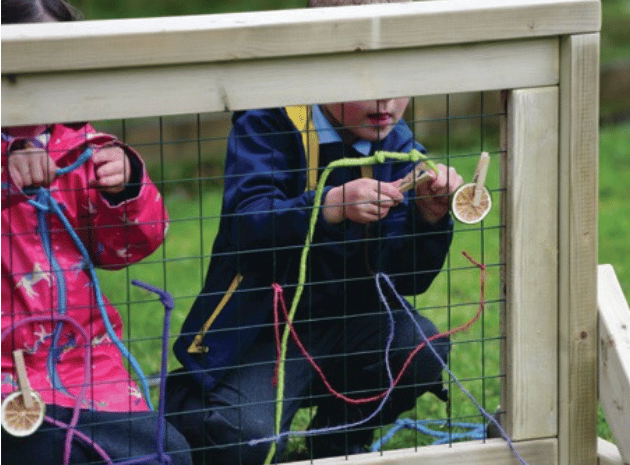
2 to 3: Provide large weaving frames with netting or crates. Children can thread a range of materials, such as ribbons or long grasses. These broad movements help establish bilateral coordination.
4 to 5: Offer smaller frames with shorter materials, and pegs. Children must pinch, pull and thread with greater accuracy, strengthening their finger control.
6 to 7: Introduce more resistant materials such as rope or flexible willow. Simple pattern weaving or knot work remains safe but requires refined, skilful manipulation.
Linking strength and fine control…
2 to 3: Loose parts such as crates, blocks and tyres encourage lifting, arranging and balancing. These activities help build core stability and shoulder strength.
4 to 5: Add ropes, lighter planks, log slices and bungee cords. Children can explore knotting, threading and joining, which helps develop stronger hands and better coordination.
6 to 7: Introduce small pulley systems, simple hoists or den-building kits. These experiences require knot tying, directional pulling and precise placement of materials.
To support fine motor development across ages, try the following:
Outdoor continuous provision offers unique opportunities for developing fine motor skills because it naturally blends strength building with practical tool use and real-world purpose.
Phil Armstrong is senior education lead at Early Excellence. Discover more about transforming your outdoor learning provision and practice and download free audit tools at the Early Excellence website.

Why play is essential to early childhood development
Editors picks
5 ways to make sure a hatching project is ethically run
Editors picks