Kayte Cooling-Smith explores the hidden power of expressive arts and design…
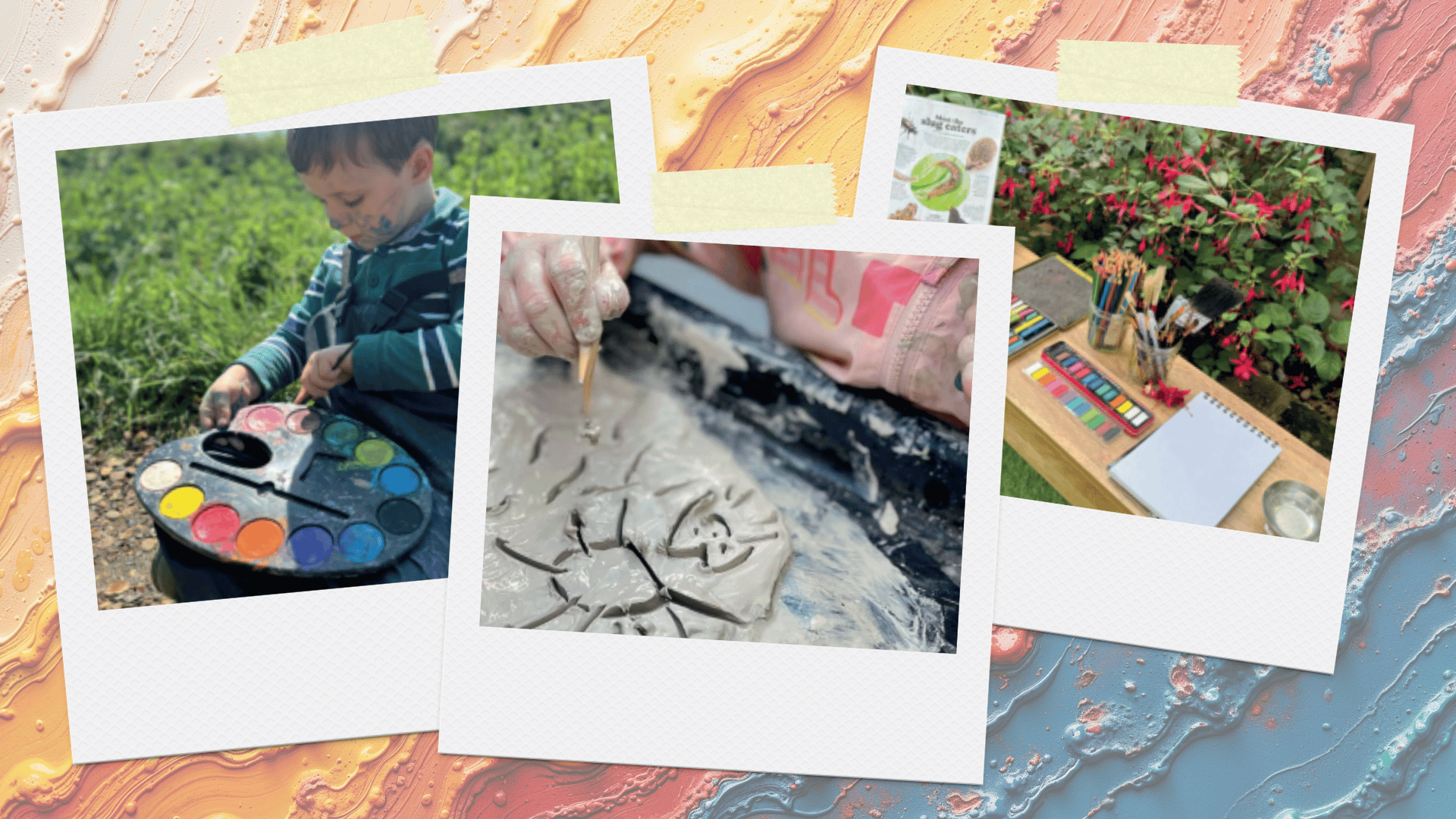
Over recent years, there has been a clear shift in how we view expressive arts and design (EAD) in the early years, and a growing realisation that in many cases, the value for children is in the creative process rather than a perfect finished product.
It’s no longer common to see a wall of 30 identical paper-bag owls or a washing line of hand-print bunnies crossing the room, and rightfully so.
These adult-directed activities give children the opportunity to be artistic, develop physical skills and demonstrate some loose understanding, but they hugely restrict their creativity and limit the opportunities they need to be uniquely expressive.
Increasingly now, we see settings with a more open approach – one where children are free to create with no expected outcome and with access to a wider variety of creative resources as part of continuous provision.
The end-goal is no longer a practitioner-manipulated bunny, sent home to delight parents; instead bags are filled with random pieces of cut-up paper, a button glued to a lolly stick, an egg box covered in googly eyes, and a painting of a boat – only identifiable as one prior to the child covering the whole page in thick brown paint.
A few years ago, we might have whipped that away before the child “ruined it”. Each of these handmade treasures very much celebrates a child-centred approach to EAD, and children’s outcomes are most certainly improved because of it.
We’ve also seen positive changes in the way we talk to children about their work. Instead of narrow questions such as “What is it?”, we ask, “How did you make that?”
Instead of broad comments such as “Well done!”, we make thoughtful reflections such as “I love how you’ve blended the yellow into the green.”
This shift in communication shows children that we value how they are being creative and the skills they’ve used, without putting pressure on them to give their work meaning.
And this is where we must be careful that we haven’t shifted the balance too far in the other direction – we’ve rightly moved away from judging the outcomes of children’s work, but in doing so, have we now become hesitant to interpret it?
We ask, “How did you make that?” because we don’t want to impose adult meaning, which is good practice.
But after the child implicitly or explicitly tells us what it is, or shows us through expression, it’s okay to be curious about what that representation reveals.
Back in the days of the perfect hand-print bunnies, it was easy to say that the product had no value or discernible meaning to the child because, fundamentally, it was an adult-conceived, adult-directed, adult-manipulated hand-print bunny – the hand-print being the only element the child took any part in.
But now our children have agency over their work and these moments where they are role-playing imaginatively with sticks, producing elaborate constructions with blocks, modelling with clay, and glueing googly eyes all over egg boxes offer us the perfect opportunity to learn more about them.
We can easily identify the learning outcomes in their work – the hand-eye coordination of the glue on the lolly stick, the pre-writing skills used to manipulate the clay, and the problem-solving and mathematical thinking used to carefully place the blocks.
But by focusing so intently on the how, and not so much on the what and the why, we have unwittingly restricted our own understanding of who our children are and what they are trying to tell us about themselves.
So, let’s see what we missed…
That carefully constructed block play? That was a bridge, but it wasn’t just any old bridge. It was a reconstruction of the bridge this little one drove over on his way to visit his grandparents in Wales – they all stayed in a tent for the weekend and learnt a Welsh song around the campfire.
He was singing “Mr Hapus Ydw I” (“Mr Happy I am”) while he played with the blocks. This was his first tangible representation of his Welsh heritage.
The button on the lolly stick? That was a dentist mirror – the one the dentist uses to look inside your mouth and check your teeth. This child’s mummy is a dentist, and they went to work with her the other day.
The picture of the boat covered in brown paint? Well, we know that this child loves to cover their hands and arms in paint too, and so this is another example of schematic play – it’s their birthday next week, so we could offer an invitation to wrap presents linked to their enveloping schema.
And what about the egg box with the googly eyes? Well, at first this child just really enjoyed sticking the eyes to the box and counting how many they could fit on, but then they realised it looked like the eyes of the spider they were a little afraid of in the nature book, and now it’s more than just an egg box with eight googly eyes stuck on – it’s a tarantula, and this child isn’t afraid of it any more.
And there we have it – taking time to be gently curious about what children have produced shows how they often weave together mathematics, language, scientific thinking, personal experiences, memories, ideas and emotions into their creative play, giving us as practitioners a much deeper understanding of who each child is.
When we notice that both the process of being expressive and the finished creative product are a representation, EAD becomes far more than just another area of the curriculum and evidence of creativity; it becomes evidence of thinking and the rich interconnectedness of children’s learning.
So, the next time a child proudly hands you an egg box covered in googly eyes, resist the urge to simply admire the glueing skills or praise their creativity.
Instead, pause and wonder, what story is this child telling? What memory are they revisiting? What connection are they making?
Because more often than not, the most valuable thing a child creates isn’t the model itself; it’s the opportunity for us to better understand the unique individual who made it.
What is the child trying to communicate that they may not yet have the words to say? Consider whether the marks, construction, movement, role play or creation represent an experience, emotion, memory or idea.
What connection is the child making? How might this creation link to a recent experience, a fascination, a story, a relationship or something they have noticed in the world around them?
What thinking has taken place that isn’t immediately visible? Rather than focusing solely on the finished product, reflect on the decisions, problem-solving, experimentation and revisions that happened along the way.
How has this child chosen to represent their understanding? Why this medium or these materials? Why this story, movement, model or image? What does their chosen form of expression reveal about how they make meaning?
What might I learn about the child if I view this as communication rather than creativity? How could this deepen your understanding of their interests, identity, relationships, emotions or current theories about the world?
Kayte Cooling-Smith is a multi-award winning childminder based in Essex and a judge for the Teach Early Years Awards 2026.

P4C – 3 activities to get preschoolers thinking
Editors picks